This post may contain Amazon or other affiliate links that allow us to earn a small commission at no extra cost to you. Please see our Disclosure Policy for more info.
The mention of kefta (ground or minced meat) always brings deep memories of mine to the surface. All of them are related to my father, who passed away in 2009.
My family is originally from Fez but had to move to Casablanca for work and studies. Like many Fassis, my parents settled in the big city where they raised four children. Going back to Fez to visit the rest of the family and friends meant many hours of driving on the route nationale as there was no highway yet.
On our way to Fez or on the way back to Casablanca, we would stop at Khemisset between Rabat and Meknes or make a small detour to Boufekrane (famous for its water and the quality of the red meat), about 15 kilometers just beyond Meknes. We weren't the only travelers to do this.
It was an unwritten rule that each coach journeying through Khemisset had to stop. In fact, people anticipated the stop in this town as if it was the purpose of their trip. That's because Khemisset was regarded as the capital of kefta and other tasty skewered meat (brochettes in French or qotban in Moroccan Arabic).
These kebabs and other grilled meats were served in unpretentious restaurant-grills on both sides of the road. Whether it was for a snack or a meal—even if one had a meal just an hour ago—there was no way anybody would think of missing it. It was just like a religious duty for connoisseurs!
Unfortunately, this reputation seems to have faded away and the quality is no longer what it used to be. This is likely due to the development of a highway, which meant that the masses no longer traveled via the national road. With the decline in demand came a decline in quality.
The Smoke Market
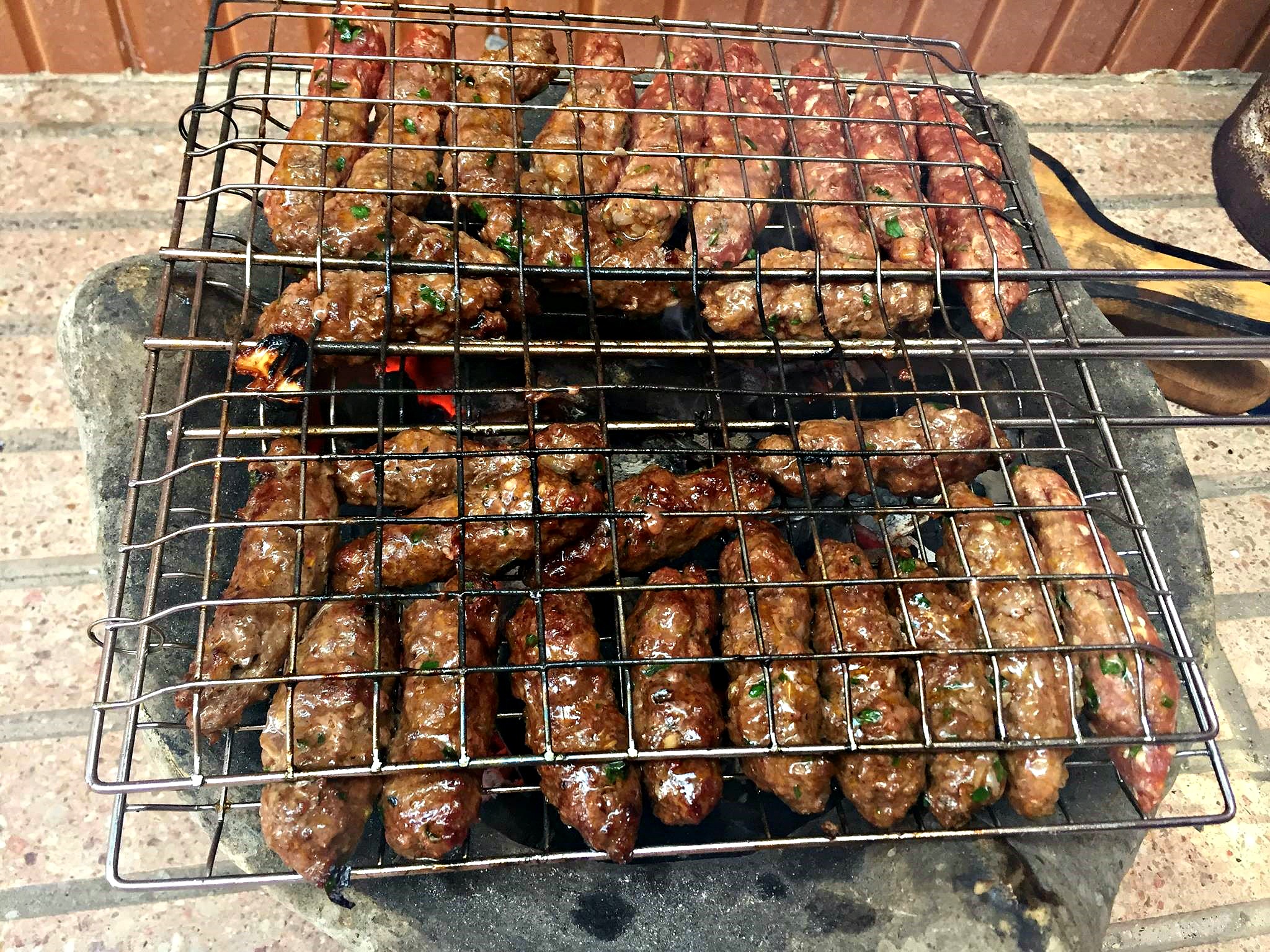
Some fast food restaurants or street food joints similar to where we ate in Khemisset offer an enticing spectacle before the food. It is something called "the smoke market" which refers to the smoky allure of grilled food.
People are naturally drawn in by the mingling aromas of charcoal, fat dripping over the fire and enchanting spices, and they follow their senses to arrive at the grill, hungry as ever.
At these modest eateries, you select raw meats from a butcher and then carry your selection a few steps away to the man in charge of grilling. Then you pick a table and order your tea and salad while waiting for your grilled food to be served. It's a butcher-restaurant formula that is very satisfying and very popular among Moroccans.
It's worth knowing that many of these butchers may be kessabs, a name meaning that they own the cattle which are the source of the meat in their shop. This is probably one of the most straight-forward distribution channels one might come across.
What Makes a Good Moroccan Kefta?
To many of us, the very best kefta to be found in Morocco was Kefta dyal Gharb from the northwest El Gharb region where Khemisset and Boufekrane are located. It's an area known for its first-class agricultural diversity, including abundant grazing land for cattle.
While each kfaity (kefta maker) or butcher keep their recipe secretly guarded, one will agree that a happy animal leads to good meat. The age of the animal is equally important; the best meat for kefta must come from a cow over three years of age.
The way the meat is processed is important to the texture of the kefta. Those who have made kefta by hand-chopping using mdaqq'a (a method similar to the one used to make steak tartare) and lived to tell the tale, will all agree that hand-chopping is worth the effort and that mechanical grinding or mincing takes away from the quality.
That's because the best texture and flavor are acquired only if the meat retains both its plasticity and the natural juices of each part used. Automation diminishes the quality of both and the ground meat becomes less sticky from the brutal hashing of the machine.
While most of us will likely buy mechanically ground meat, we can at least compensate with the use of fresh spices, a bit of fat, and good handling.
All meat can become kefta except offal, although I have heard that some butchers do throw a kidney into the mix. Either way, using pieces of meat from different areas is key.
It seems that lean cuts mixed with fatty cuts make the best kefta. My family recipe is on par with this practice.
The pieces of choice for kefta connoisseurs are leg of lamb along with several parts of the abdomen such as flank, middle chest and large chest (locally called bouswita or bouswite). These latter cuts are famous for the massive presence of muscle fibers, which are balanced out by the naturally tender texture of the leg.
The ratio of fat to the meat should be at least 25 percent fat to 75 percent meat. Less fat than that will not deliver the experience we all look for when we want to reproduce the best kefta.
In fact, added fat which creates drippings over charcoal is an essential ingredient on its own. Ideally, we select the sheep fat surrounding offal; this could be kidney fat (suet) or caul fat, locally called m'jebna or 'ain douara.
The choice of these fats is essential to the quality of Moroccan kefta as you may have tasted it in reputed restaurant-grills across Morocco. So, the logic of wanting a lean kefta while seeking to reproduce that mythical flavor found across Moroccan fast food restaurants can't real